AI automation in Nottingham: you are the wiring.
This week a big sales-software company put its customer records inside an AI assistant and made one promise: connect it once and the whole team sees the same customer. Worth stealing. In most Nottingham small firms, the thing connecting the calendar, the inbox, the invoice app and the notes is still the owner, retyping.
What actually happened this week
Two stories, both about plumbing. One AI lab released a new version of its model that costs less to run when it keeps re-reading the same instructions, which it does all day if you leave it working (the lab's own announcement). That mostly matters to people who build software. You are not one of them and do not need to be.
The second story is the one to keep. A large sales-software company and that same lab tied their products together so an AI assistant can work straight from the customer list. An administrator connects it once, every seller gets it, and nobody sets anything up per person. Big companies with big budgets now have that for their sales teams. Nobody has quietly shipped it to a two-person agency in Hockley. But the idea is right, and the idea is what matters for you. The product is beside the point.
Nottingham runs on small firms and four apps each
Look at who is actually trading here. Design studios and two-person agencies in the Lace Market and up through Hockley. Electricians, plumbers and heating engineers working out of Bulwell, Arnold and Carlton. Salons and clinics along Central Avenue in West Bridgford and Beeston High Road. Independents in Sneinton Market. Small fabrication and engineering units around Colwick and Lenton. Letting agents and landlords with two universities' worth of student housing in Dunkirk and Lenton. Furniture makers and upholsterers still trading out of Long Eaton.
Government figures show the shape of it. The large majority of UK businesses employ nobody except the owner, according to the business population estimates, and Nottingham is no different. So the person who quotes the job also books it, invoices it, answers the follow-up email and remembers that the customer's side gate sticks. Each of those lives in a different app. None of the apps know about each other.
The real bottleneck: the owner is the integration
A normal Tuesday for a heating engineer in Arnold. An enquiry lands by text. The address goes into the phone's notes. The visit goes into the calendar by hand. The quote is typed in the invoicing app, with the address again. The customer replies by email asking to move it, so the calendar gets edited and a reply gets typed from scratch. Two weeks later the invoice goes out with the address typed a fourth time. The note about the sticking gate is nowhere, because it was said out loud on the doorstep.
None of that is hard. It is retyping, and retyping is where mistakes come from. The wrong postcode on the invoice. The old phone number on the reminder. A follow-up that never went because the enquiry lived in one app and the diary in another. We wrote about the general shape of this in everything still comes back to your desk. The Nottingham version is the same, with worse parking.
The tempting answer is to connect the apps yourself. Do not. Connecting apps is a job. It comes with its own passwords and its own Sunday evening when something silently stopped syncing in March. You would be swapping one kind of admin for a more technical kind. What makes the big-company announcement interesting is that it skips that step entirely. Connect once, and every helper reads the same record. Hold every tool you look at to that.
What the crew already does with this
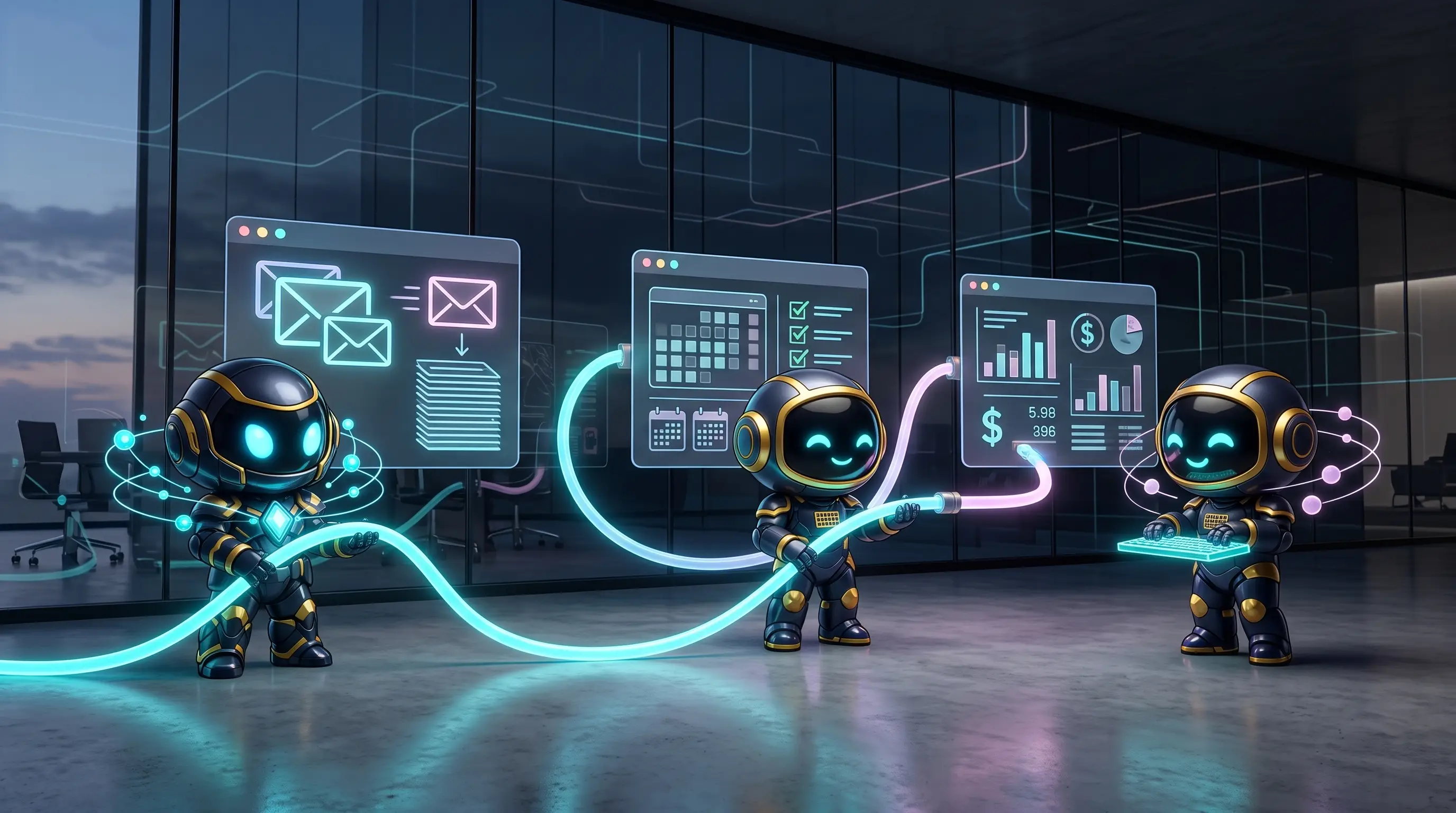
There is very little for you to set up. WorkMate OS is a crew of AI teammates with named jobs: inbox, bookings, accounts, sales and the rest. Every one of them reads and writes the same shared Brain. Tell the inbox mate that the Sneinton customer prefers texts and that their side gate sticks. The bookings mate knows it when it schedules the visit, the accounts mate has the right address when it drafts the invoice, and the sales mate knows the job is done when it drafts the follow-up. You said it once. That is the whole trick, and it is what one shared Brain was built for.
Corrections stick too. Say the Long Eaton workshop moved units and it is moved everywhere, across sessions, not only in the app you happened to have open. The brand kit is stored the same way, so a reminder from the accounts mate reads like you rather than a template, without you retyping your tone into each task.
You still decide what goes out. Anything to a customer follows draft, review, send. The mate drafts the rescheduling reply. You read it and approve it. The activity log shows what was looked at, when, and what was drafted, so "did anyone tell them the visit moved" gets answered on a screen instead of by a feeling in your stomach. The fuller argument for that gate is in who is allowed to press send.
What to do this week
Start with the part that has nothing to do with software. Take one real job from the last fortnight and count how many times you typed the same customer's name, address or phone number into something. Include the text you sent from the van. Most Nottingham owners who do this get a number higher than they expected, and never because they are disorganised. Nothing they use talks to anything else.
Then write down, on one side of paper, the facts about a customer you would want every helper to know: how they like to be contacted, anything odd about the site, who pays late and who never does. That page is what a shared Brain gets told. If the tool you are looking at cannot hold that page once and use it everywhere, it is another app to keep in step. You have enough of those.
For the wider version, the plain-English UK guide covers the same ground without the local detail.
The honest version
You do not need to understand what the AI companies announced this week. One line of it reaches you: connect once, and everyone reads the same record. Big firms are buying that for their sales teams. You can have it for a business of one, and if you use WorkMate OS the crew already works that way. Nothing to install, nothing to wire up.
The retyping was never dedication. It is a gap in the tools, and you have been filling it with your evenings. Stop.
WorkMate OS Launch Access is now open. Start with the one-page customer facts. Ten minutes.