
AI automation in West Yorkshire: five towns and one working day.
West Yorkshire is five towns and a lot of driving between them. For most small firms here, the real cost of the week sits in the hour between the job in Brighouse and the job in Pudsey, and in the fact that nothing on the admin pile moves until you are back at a desk.
Spread over five towns
Look at who actually trades here. Joiners, sparks and plumbers working out from Armley, Beeston and Pudsey and taking jobs anywhere from Otley to Ossett. Salons, barbers and clinics in Chapel Allerton, Horsforth, Saltaire and Hebden Bridge. Independent shops and cafés round the Piece Hall in Halifax, Kirkgate Market in Leeds, and up the Calder Valley. Small engineering and textile firms still going in Huddersfield, Elland and Cleckheaton. Food and logistics outfits strung along the M62 through Castleford and Normanton. Two and three person agencies and professional firms around Wellington Place, Leeds Dock and Little Germany, a street away from businesses with entire operations teams and none of the same support.
The West Yorkshire Combined Authority describes an economy spread across five council areas rather than gathered into one centre. That is a nice line in a strategy document. In practice it means your customers are in five towns and your van is in one of them at a time.
The government's own business population estimates make the rest of the shape plain: the large majority of UK businesses employ nobody except the owner. So the person driving is also the person who answers the phone, writes the quote, moves the booking and chases the invoice.
The bottleneck is the hour between jobs
Ask an owner here where the week goes and you get the same answer in different words. The morning job overran. The next one was forty minutes away. By the time you sat down, it was gone six, and there were eleven things waiting.
The enquiry that came in at half two is the expensive one. It did not get an angry email. It got nothing, then a reply the next morning, by which point someone else had already sent a price. Nobody writes to tell you they went elsewhere, so this leak never shows up as a problem. It shows up as a quiet month.

What actually changed
If you have heard anything about AI lately, it probably arrived as "the AI can do things by itself now". That is roughly right, and the plain version is duller and more useful.
Until recently, these tools were screens. You opened a tab, typed, read what came back, copied it somewhere else, and closed the tab. The clever part was never the bottleneck. The bottleneck was that you had to be sat in front of it, driving. Which meant it only ever helped during the hours you already had free.
What moved is that the screen stopped being the point. Work can now be handed over as an instruction and come back done, without anyone watching it happen. For a firm covering half of West Yorkshire from a van, that is the whole difference. The admin stops waiting for you to get back to a desk. We wrote about the shift in the AI that keeps working after you shut the laptop.
What has not changed
It still has to know your business, and that part is on you. A tool that does not know you stopped covering anything past Skipton in March, that Saturdays are booked out, or that anything over five hundred pounds needs a deposit will write confident nonsense at speed. Faster wrong is worse than slower right.
And it still has to sound like you. A reply that reads like it came from nobody in particular costs you more than a slow one, especially in a trade where half your work arrives by word of mouth. We went into that in why AI output feels generic.

What the crew does about the driving
The part worth explaining properly is whether any of this runs while you are not there. It does.
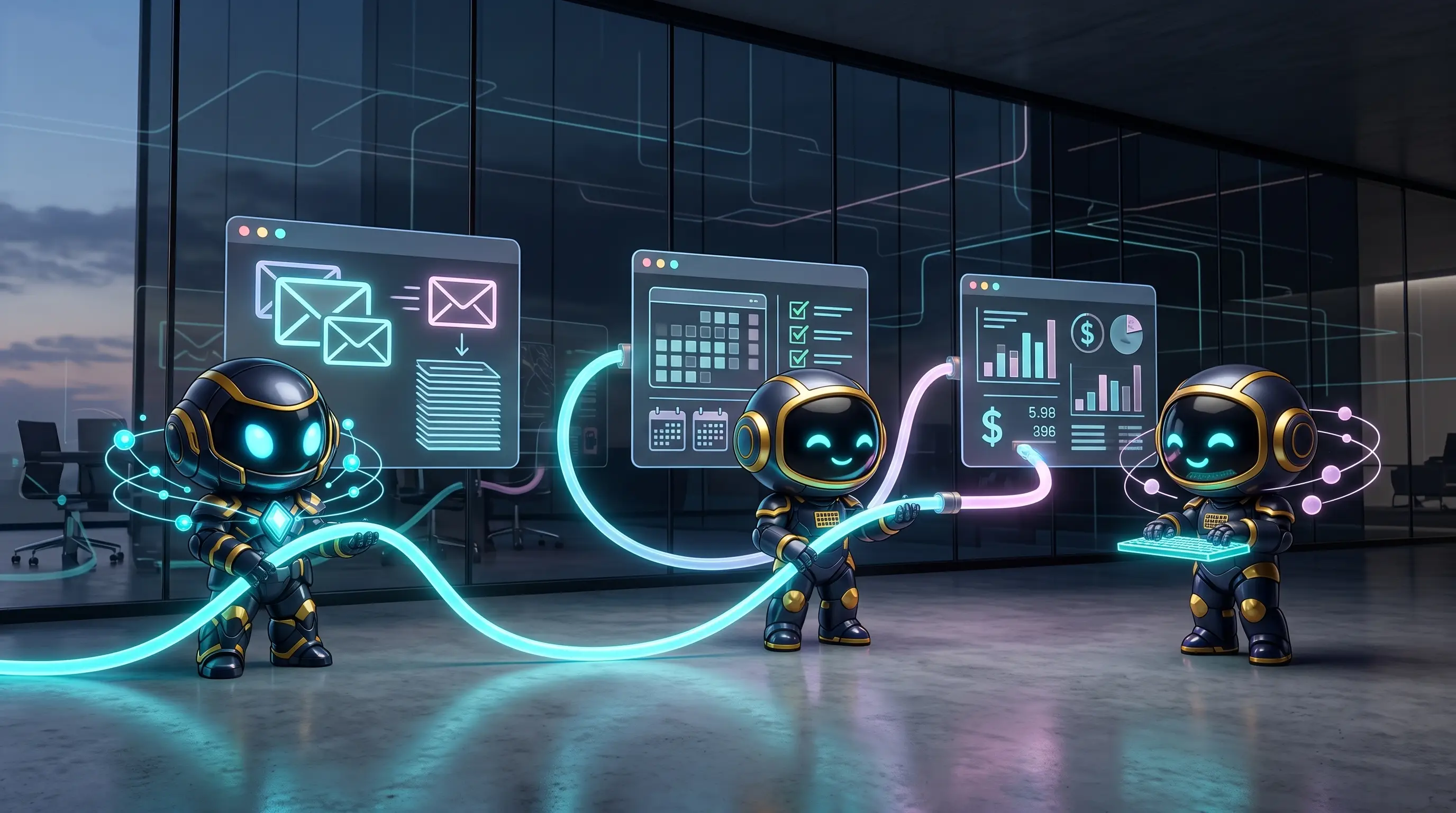
WorkMate OS is a crew of named AI teammates with jobs, rather than a box you type prompts into. One handles the inbox. One handles bookings. One chases money. One writes in your voice. They are not waiting for you to open them.
They also do not need you to relay between them. Every mate reads and writes the same shared Brain, so when the mate answering an enquiry learns that a customer wants a Thursday in Wakefield, the mate handling bookings already knows. You are not the messenger standing in the middle of your own tools. That is the point we made in one Brain, never off the clock.
Your brand kit lives in the same place: your voice, your tone, the words you will not use. Set once, not re-explained at the top of every task.
Anything going out to a customer is drafted, reviewed and sent on your approval. That matters more when you are mobile, not less. Approving a good draft at a layby takes seconds. Writing one from scratch at nine at night takes the evening.
And there is an activity log, so the honest answer to "what has it been doing all afternoon" is a screen you can look at rather than a feeling.
Where to start this week
Start with the part that has nothing to do with software.
Write down the ten things you repeat to people every week. Your prices and how they vary. The towns you cover and where you stop. Hours, and the days you do not work. Deposit rules. The jobs you turn down. How you want a first reply to sound. What happens when someone goes quiet.
That list is the whole exercise. It is the thing you have been carrying between five towns in your head. Once it is written down, handing it over takes an afternoon and stops needing to be handed over again.
Then take the two jobs that leak: the first reply to every enquiry, and one polite nudge two days later to anyone who has not come back. Those two recover more work than most owners expect, and they are the two nobody ever gets round to. The wider list is ranked in 10 jobs to hand to automation first.
The honest version
You do not need to become technical, pick anything, or understand a word of what was announced this month. There is nothing for you to install, connect or maintain.
If you run the kind of West Yorkshire business where the day is spent between towns and the paperwork happens after dark, the useful bit of all this is small and specific: the work stops waiting for you to sit down. If you want the version of this focused on Leeds itself, we covered it in teaching it once instead of ten times.
WorkMate OS Launch Access is now open. Start with the ten facts. You can write them on the back of an invoice between jobs.