Everyone calls it an "AI agent" now. Here's what that word has to actually mean.
A creator's new course this week spent its whole first lesson on one point: most things called an "AI agent" are just a chatbot with a new coat of paint. What matters is whether it can carry a job through several steps on its own, and whether you still get to see it before it touches a customer.
"Agent" has become the word every tool puts on its homepage. That's not a technical detail you need to follow. But the gap it's papering over is real, and it's the exact gap that decides whether an enquiry sitting in your inbox at 6pm gets a reply by the time you open up tomorrow, or just sits there for another day.
Why this is the bottleneck, not the buzzword
A chatbot needs you at the keyboard. You ask, it answers, the conversation ends when you close the tab. Nothing happens while you're on a job, in a van, or asleep. If your business runs on enquiries — someone messaging about a quote, a booking, a late invoice — a chatbot doesn't move any of that forward without you there to drive it.
An agent is built differently: it can pick up a task, work through the steps needed to move it on, and hold what it learned so the next step doesn't need re-explaining. That's the difference between "I asked it and got an answer" and "it got the thing done while I was busy doing something else." For a business where enquiries go quiet because nobody replied fast enough, that second kind is the one that actually closes the gap.
What this changes for you
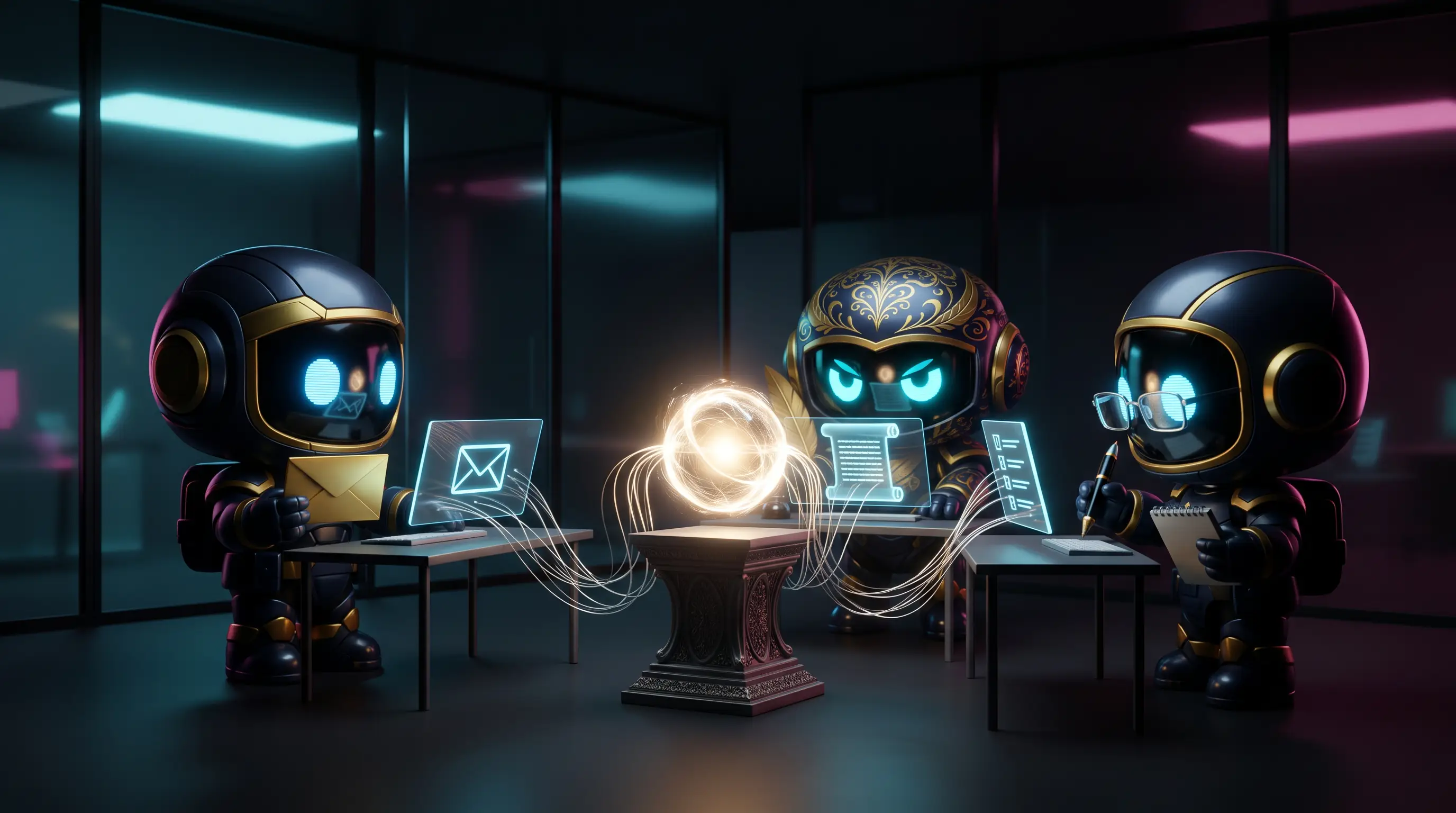
Nothing you need to set up. This is already how the crew is built. Each mate — the one that watches your inbox, the one that handles bookings, the one that chases unpaid invoices — reads and writes to the same shared memory, so a fact told once stays known. They draft the reply, the chase, the follow-up. You approve before anything reaches a customer. That's the agent part doing the work, and the review step staying exactly where it belongs: with you.

So when you hear "our tool now has an AI agent," the honest question is whether it's still working an enquiry three steps after you looked away, and whether it shows you the draft before it goes anywhere. If the answer to either is no, it's a chatbot wearing the word.
FAQ
What's the difference between a chatbot and an AI agent?
A chatbot answers one question at a time and forgets you the moment the window closes. An agent can carry a task across several steps on its own — read something, decide what it means, draft a response, and remember it next time — without you re-explaining the situation each time.
Does WorkMate OS reply to customers without me seeing it first?
No. Every mate drafts, nothing goes out to a customer until you approve it. The agent part is the drafting, remembering and chasing done for you — the sending stays yours.