
Your software is growing its own AI. That is not a team.
If your booking system, your accounts package and your inbox have all announced an AI assistant this year, nobody is really asking you to pick the cleverest one. You are being handed four helpers who each see one corner of your business. Worth knowing before you get excited. What costs you a day a week was never a shortage of helpers. It was the walking between them.
What has actually changed
Quietly, over the last few months, the software makers settled on a decision. AI would not be a separate product you go and buy. It arrives inside the things you already pay for. Microsoft announced on 28 July that its business data platform now ships as a ready-made add-on into every major AI assistant rather than one of them. Even Epic Games has published one for its game engine. Different industries, same move.
For you the practical effect is small, and mostly good. Nobody will ask you to install anything. One morning a panel appears in a tool you have used for years, and it can answer questions about what is inside that tool.
What the announcements skip over is how much it can see. An assistant built into your accounts package can see your accounts. That is the whole boundary. It does not know about the enquiry that came in on Friday night. It did not hear what you promised on the phone on Monday. It cannot tell whether the job it is invoicing was ever finished.
Four helpers, one owner, still doing the joining up
Take one ordinary job. An enquiry lands on Facebook. You reply. It turns into a quote. The quote turns into a date in the diary. The date turns into a job. The job turns into an invoice. The invoice turns into three weeks of not being paid.
Now add an AI to each tool. The messaging one drafts a reply without knowing your availability. The diary one books the slot but never sees the quote. The accounts one raises the invoice with no idea the customer asked to be billed at the end of the month. Every handover between them is still a person, and that person is you, at ten at night, with the laptop open on the kitchen table.
Four assistants is not four times the help. It is four things that each need telling, while one human carries the job from one to the next.
The second cost: telling each one who you are
Underneath sits a smaller tax, and it is the one owners feel most. Every one of those assistants starts life knowing nothing about you. Not your prices. Not your area, or the fact you do not take on jobs south of the river, or that you never call customers "clients", or that you charge a call-out fee but waive it if the work goes ahead.
So you type it in. Then you type it again, in the next tool, in slightly different words. A fortnight later one of them writes something that does not sound like you, or quotes a price you stopped using in spring, and you go back to doing it yourself. That is usually the moment people decide AI is not for them. We wrote about why the output ends up sounding like nobody in why AI output feels generic.
The industry has worked this out for itself, in its own language. The same week, engineers were arguing that know-how should be stored once and read by every assistant rather than copied into each one, on the grounds that the alternative is "maintaining copies" instead of "maintaining a source". Same problem. Yours.

How the crew is arranged instead
The other way round, is the short answer, and it is worth being precise about what that means.
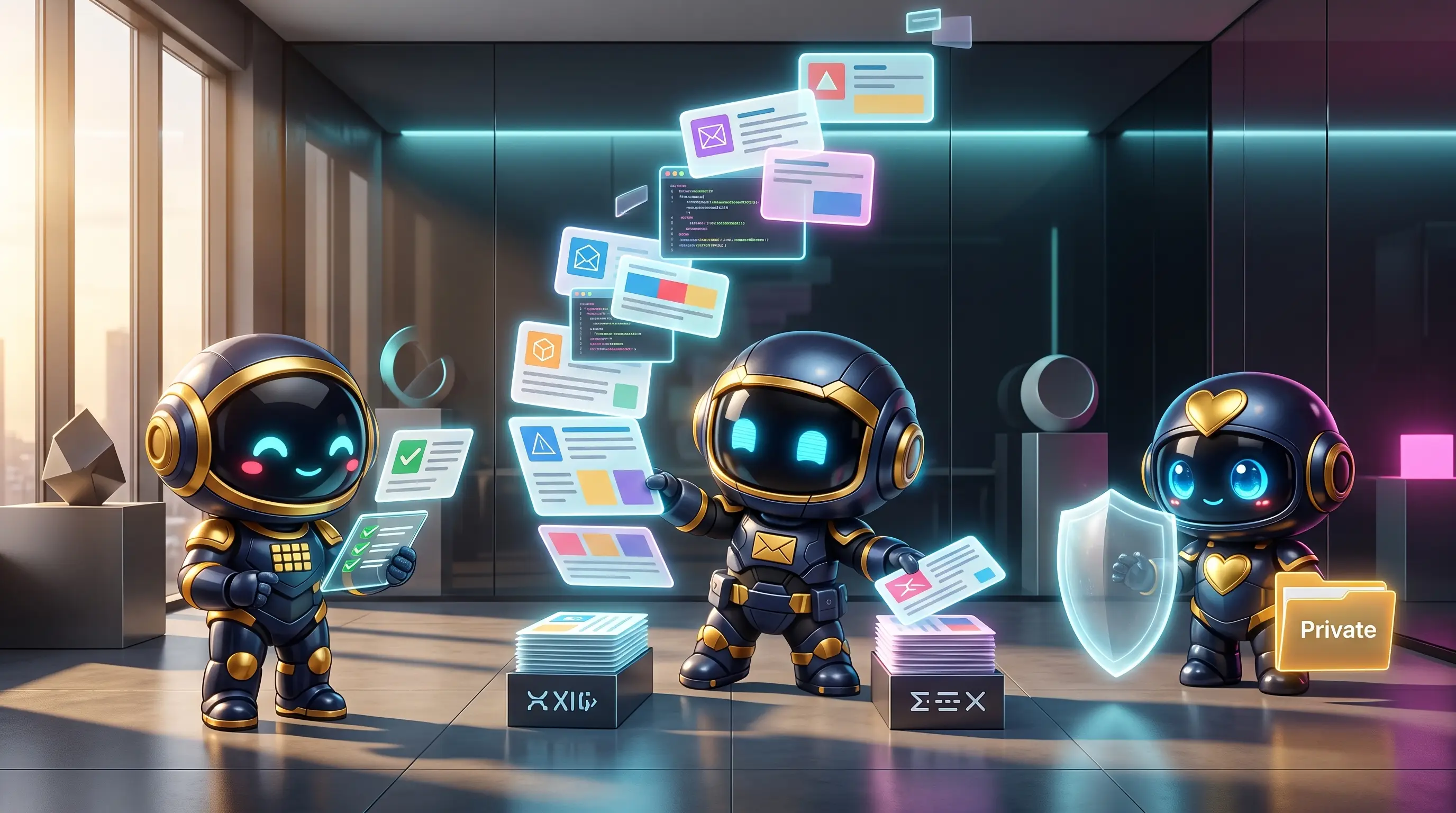
WorkMate is organised around jobs, not software. There is a mate for the inbox, one for bookings, one for accounts, one for sales, one for copy. They are not assistants trapped inside four products. They are a crew working on the same business, so the enquiry, the quote, the diary entry and the chase-up are one continuous piece of work rather than four disconnected ones. That distinction is the whole product, and we set it out in not another chatbot.
Underneath them is one shared Brain. Tell any mate something once and all of them know it. Correct one of them and the correction sticks, next week and next month, not just for the rest of that conversation. Your voice, your tone and the words you refuse to use are stored as a brand kit rather than retyped at the top of every task.
Where you need real depth in one area, that is what modules are for. Booking that actually books. Invoicing that actually chases. A voice module answering a real phone number. They add depth without adding another island.
The safety rail matters more the moment work joins up across jobs. Anything going out to a customer follows draft, review, send. You approve it. The activity log shows what ran, when, and what it produced, so joined-up work does not mean work happening out of sight.

What to do about it this quarter
Nothing dramatic. If your accounts software adds an AI panel, use it for accounts questions. It will be good at them. Nobody needs to rip anything out, and you should not pay for the same capability twice.
Just be honest with yourself about which problem you actually have. If your problem is "I cannot find last quarter's numbers", a helper inside that tool solves it. If your problem is "the enquiry, the quote, the booking and the invoice all live in different places and I am the only thing connecting them", no amount of tool-level AI touches it. That job needs something sitting across the whole week, holding what it has been told about your business, still knowing who you are on Monday morning. The version of that argument for evenings and weekends is in the AI that keeps working after you shut the laptop.