
Twelve helpers, or one good hire?
The AI workforce market has split cleanly in two, and both halves leave the small business owner holding the same missing job. On one side sit the wide suites, selling six or ten or twelve named helpers for about what you pay for a phone contract. On the other sit the single-purpose tools: inbox, calendar, meeting notes. They do one thing well and charge two to four times as much for it. The narrow ones are winning on trust and the wide ones are winning on price. Neither is winning on the thing that actually costs you your evenings.
Wide and shallow
Buy the suite and you get an org chart: an assistant, a social one, a sales one, an SEO one. Read the independent testing and the same sentence turns up against nearly every member of the roster. It prepares, but it does not finish. The assistant drafts emails and leaves them unsent. The social one writes captions but does no video, which is where most of the reach now is. The SEO one writes posts and does no auditing, no rank tracking, no keyword gap analysis. The legal one summarises but cannot draft.
None of that is fraud. It is honest scope. But add it up from the owner's chair and the suite has not taken twelve jobs off your desk. It has taken the first eighty per cent of twelve jobs and handed the last twenty per cent back to you, the part that needs judgement, access and a send button. Twelve times.

Narrow and deep
The single-job tools are having a good year because you can hold the whole promise in your head. One does your inbox and calendar properly. One answers the phone properly. No meter to interpret, no roster to learn, and when it works you know precisely what you bought.
The limit shows up the moment work crosses a boundary. The inbox tool spots the enquiry and cannot quote. The phone tool books the job and cannot invoice. You stay the integration layer, carrying context between products, and that carrying is exactly the work that makes a week feel full. Practitioners building this stuff for clients now describe integration, rather than intelligence, as the real bottleneck: an agent that cannot reach your existing systems "is little more than a chat interface," and the firms that do get cross-system integration report saving 12+ hours a week.
The part both halves skip: the handover
Real work in a small business is a chain, not a task. An enquiry arrives on Instagram. It needs answering in your voice, qualifying against what you actually offer, quoting from your real prices, booking into your real diary, confirming, reminding, invoicing, chasing and, if it went well, asking for the review. Nine steps, every one of them trivial. What costs you is not any single step. It is that you are the connective tissue between all nine, and you are only available some of the time.
A shallow suite breaks that chain twelve different ways. A deep single tool executes one link perfectly and drops the rest. What a small business needs is depth and a handover.
How WorkMate OS is built
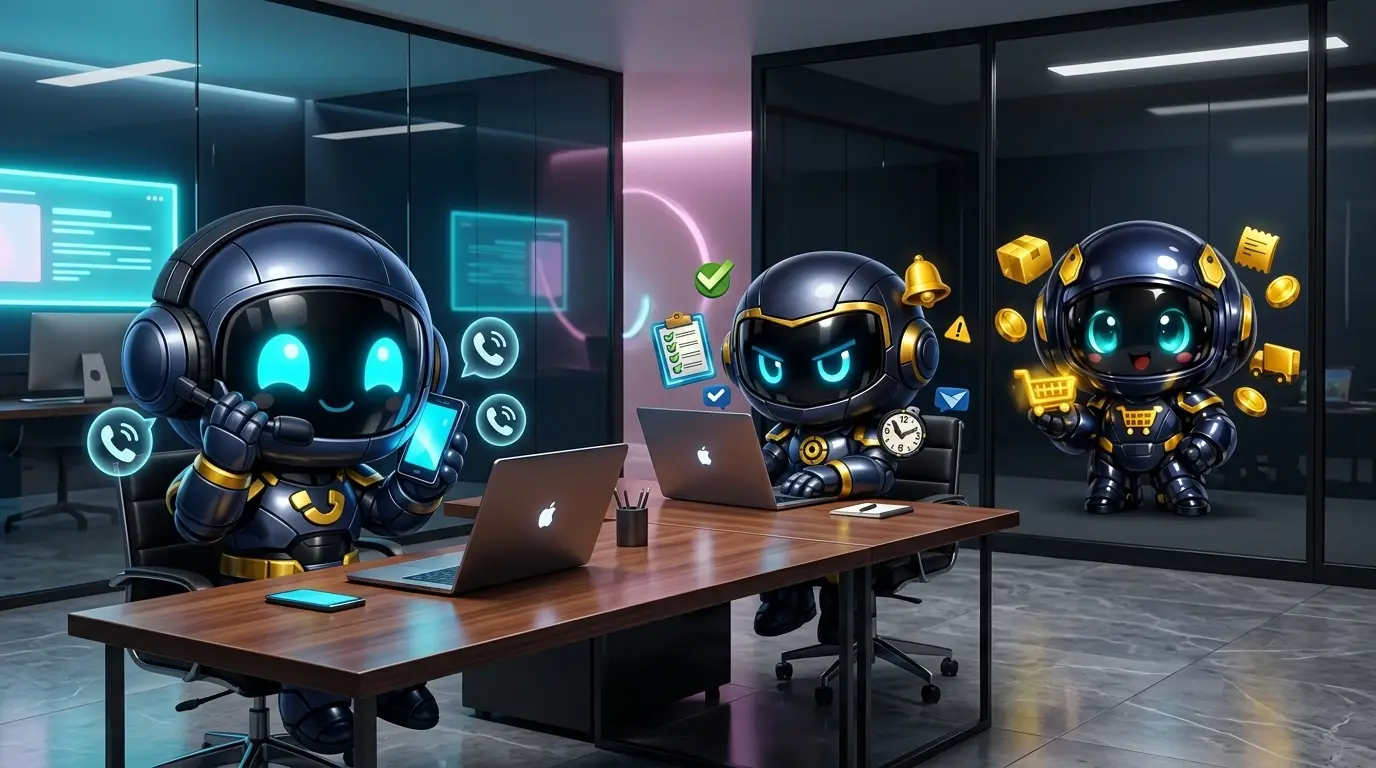
WorkMate OS is a crew, not a menu. Each mate has a name and a job — inbox, bookings, accounts, sales, copy, design, SEO, security — and they all read and write the same shared Brain. So the enquiry your inbox mate triages carries its full context to the mate who quotes it and the mate who books it. That is the handover, and it is the product.
Depth comes from modules rather than more names. Booking that really books. Invoicing that really chases, a voice module that answers the phone on a real number, a studio that makes the video instead of describing one. You unlock the depth you need on your tier instead of paying for a roster you will never use.
And the whole chain runs on draft, review, send. The crew carries the work end to end and stops at the point where your judgement is worth something. You are steering, not rowing, which is the pattern we described in Monday, planned in one hour.

What to check on any product in this category
Does it finish, or prepare? Ask specifically whether it sends,
books, files and chases, or only drafts.
Do the helpers know each other? If two of them cannot use the same
fact about a customer, you have bought bundled subscriptions.
Where does it stop? A good product stops where judgement starts. A weak
one stops where the work got difficult.
What does the roster cost you in learning? Twelve names you must
remember to invoke is a rota you are managing, unattended.
Launch pricing for the crew is £19 (Mini), £49 (Office) and £99 (Pro) a month, and the full breakdown of what each tier unlocks is on the pricing section.